Running a small hotel or guest house means juggling bookings, guest communications, and front‑desk operations often with just one or two staff members; an AI receptionist can shoulder the repetitive workload while you focus on hospitality.
What an AI Receptionist Actually Does
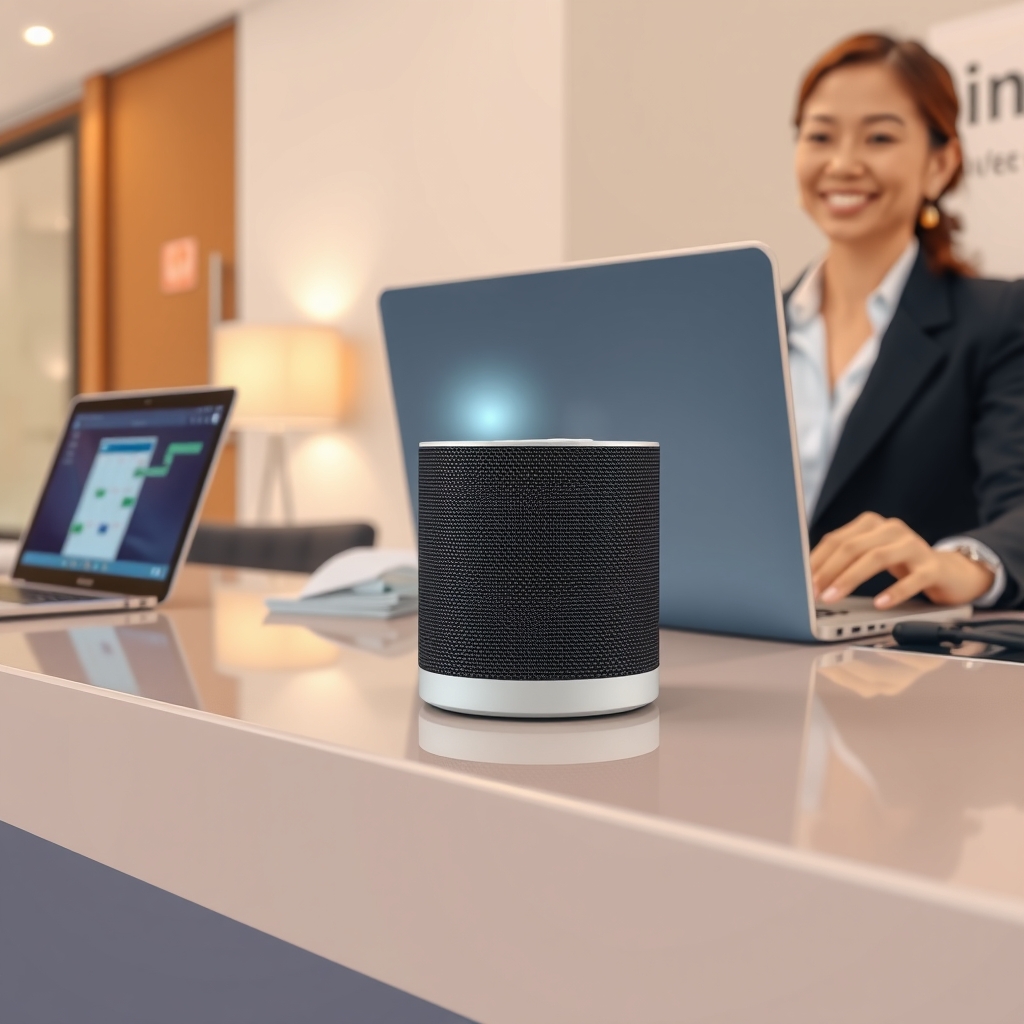
At its core, an AI receptionist is a conversational agent that handles inbound messages through phone, SMS, web chat, or voice‑assistant interfaces. It can parse natural language, pull reservation data from a property‑management system (PMS), and respond with confirmations, check‑in instructions, or local recommendations. The key is integration: a well‑wired agent talks to the same API you use for manual bookings, so there is no data duplication.
Typical capabilities include:
- Real‑time availability lookup and instant booking confirmation.
- Automated check‑in/out timing, sending door codes or key‑card instructions.
- Upsell prompts for room upgrades, late checkout, or ancillary services.
- 24/7 multilingual support using pretrained language models such as OpenAI’s gpt‑4o or Anthropic’s Claude 3.
- Basic issue triage – forwarding maintenance tickets or special requests to the human staff queue.
These functions are deterministic enough to be reliable, yet flexible enough to be customized per property.

Limits of Current Speech‑to‑Text and Intent Recognition
Even the best commercial speech‑to‑text services (e.g., Google Speech API, Azure Speech) produce a word error rate around 5 % in quiet environments. In a lobby with background chatter, the error rate climbs to 12 % or more, which can break intent detection. A senior engineer will therefore implement a fallback: if confidence falls below 0.7, the system repeats the request or escalates to a human operator.
Intent classifiers trained on generic datasets misinterpret hospitality‑specific phrasing like “Can I get a late checkout?” or “Do you have a crib?” unless you fine‑tune on domain data. A practical approach is to start with a small labeled set (≈500 utterances) and continuously augment it with live interactions, using active learning to keep the model current.
Integration with Existing Property‑Management Systems
Most small hotels run cloud‑based PMS like Cloudbeds, Little Hotelier, or ResNexus. These platforms expose REST endpoints for reservation CRUD operations. An AI receptionist must store an API token securely (use a vault like HashiCorp or AWS Secrets Manager) and respect rate limits – typically 100‑200 requests per minute – by queuing non‑critical calls.
When integrating, watch for data mapping mismatches: the PMS may use “room_type_id” while the AI logic refers to “category”. A mismatch causes silent failures that are hard to debug. Always include a schema validation step before committing any change.
Handling Payments and Sensitive Data
Regulatory compliance is non‑negotiable. PCI‑DSS requires that credit‑card numbers never touch the AI’s processing layer. The recommended pattern is tokenization: the front‑end collects the card via a PCI‑compliant widget, returns a token, and the AI passes only the token to the payment gateway. This way the AI never stores or logs raw card data.
For GDPR‑compliant guest data handling, you must give guests the option to delete their conversation history. Implement a “right to be forgotten” endpoint that wipes logs from both the AI platform and the backend storage (e.g., S3 with object‑level deletion).
Operational Costs and Performance Trade‑offs
Running a large language model in the cloud can cost $0.001 per 1 k tokens for inference on the cheapest tier. A busy boutique hotel that processes 300 k tokens per month will see a bill of roughly $300. For tighter budgets, you can deploy an open‑source model like Llama‑2‑7B on a dedicated 8‑core CPU instance with 32 GB RAM; inference latency stays under 500 ms, and monthly compute cost stays under $100 on most cloud providers.
Latency matters at the front desk: guests expect a response within two seconds. To meet this SLA, cache frequently used responses (e.g., check‑in times) in Redis and pre‑warm the model on a warm container pool to avoid cold‑start delays.
Common Pitfalls and How to Avoid Them
1. Over‑automation. Pushing every request to the AI creates a brittle system; always keep a manual override path. 2. Ignoring context. A guest who has just checked in will ask different questions than a prospective booker. Use session attributes to retain state across turns. 3. Neglecting monitoring. Without logs that capture intent confidence, error rates, and fallback frequency, you cannot spot degradation. Deploy Prometheus metrics and set alerts at 5 % fallback spikes.
Another mistake is under‑estimating the need for multilingual support. A single‑language model will alienate international travelers. Instead, route the language detection step to a lightweight model (e.g., FastText) and invoke the appropriate language‑specific LLM.
Scaling the Solution for Seasonal Peaks
During high‑season, request volume can jump from 50 to 500 concurrent sessions. Container orchestration platforms like Kubernetes let you scale the inference service horizontally. Set up an HPA (Horizontal Pod Autoscaler) that watches CPU utilization (target 60 %) and request latency, adding pods in 0.5‑core increments to keep response time under the two‑second threshold.
Cache warm‑up is essential after a scale‑out event; pre‑populate the model’s context window with the most common FAQ snippets. This reduces cold‑start latency from ~2 seconds to < 0.8 seconds on average.
Future‑Proofing: Plug‑in New Services Without Re‑training
Design the AI receptionist as a composition of micro‑services: a core NLU engine, a dialogue manager, and a plug‑in layer for domain‑specific actions. When you want to add a new service—say, a partnership with a local bike‑rental shop—you only need to write a new plug‑in that maps a “bike rental” intent to an external API call. The core model stays untouched, eliminating costly re‑training cycles.
Version your intent schemas and keep backward‑compatible endpoints. This practice allows you to roll out new features gradually, using canary releases to a small percentage of guests before full deployment.
Choosing the Right Toolchain
If you prefer a managed solution, consider Azure Bot Service with Language Studio; it provides built‑in speech, translation, and connector templates for popular PMS platforms. For full control, assemble an open‑source stack: Whisper for speech‑to‑text, FastChat for LLM serving, and Rasa for intent handling. Pair this with Terraform for infrastructure as code, ensuring reproducible environments.
When evaluating vendors, check for:
- Transparent pricing on token usage or instance hours.
- Support for webhooks that can trigger your existing PMS.
- Compliance certifications (PCI‑DSS, GDPR, ISO 27001).
Implementation Roadmap
1. Discovery. Map every guest interaction point—phone, website chat, in‑room tablet—and document the data flow. 2. Prototype. Build a minimal bot that can answer “Do you have Wi‑Fi?” and “What’s the checkout time?” using a sandbox PMS API. 3. Iterate. Add intents incrementally, measuring confidence and fallback rates after each release. 4. Productionize. Harden security (TLS, secret rotation), set up monitoring, and schedule nightly model health checks. 5. Train staff. Teach front‑desk employees how to intervene when the bot escalates a request.
Following this staged approach reduces risk and keeps the guest experience consistent throughout development.
Measuring Success: KPIs and Analytics
Without hard data you’ll never know whether the AI receptionist is delivering value. Track the following key performance indicators:
- First‑contact resolution (FCR). Percentage of queries resolved without human hand‑off. Aim for > 85 % after the initial ramp‑up.
- Average handling time (AHT). Time from user utterance to final response. Keep it under two seconds for voice interactions and under three seconds for text chat.
- Fallback rate. Proportion of turns where confidence < 0.7 and the bot escalates. A healthy system stays below 5 %.
- Upsell conversion. Track how many upgrade or service offers generated by the bot turn into actual revenue.
- Guest satisfaction (CSAT). Send a brief post‑interaction survey (1‑5 stars) and correlate scores with bot usage.
Collect these metrics with Prometheus or OpenTelemetry, push them to a Grafana dashboard, and set automated alerts for any metric that drifts beyond thresholds. Periodic reviews (weekly for fallback rate, monthly for revenue impact) keep the system aligned with business goals.
Cost Breakdown and Return on Investment
Understanding the total cost of ownership helps you justify the investment to owners or investors. Break the expenses into three buckets:
- Infrastructure. Cloud compute for LLM inference (e.g., $100 / mo for a 8‑core instance) plus ancillary services (Redis $20 / mo, logging $15 / mo).
- Model usage. Token fees – $0.001 per 1 k tokens. A 30‑room property averaging 200 k tokens per month costs $200.
- Development & maintenance. Initial build (≈ 200 h) at $120 / h → $24 k, plus ongoing support (10 % of build cost per year).
Typical ROI comes from two sources: labor savings and incremental revenue. If the AI receptionist handles 60 % of routine calls, you can reduce front‑desk staffing by one FTE, saving roughly $30 k / yr. Add a modest 4 % upsell lift on average bookings and you’re looking at $5 k / yr extra revenue. In most cases the payback period is under six months.
Frequently asked questions
Can an AI receptionist handle emergency situations like fire alarms?
No. Emergency protocols must be managed by human staff and integrated alarm systems. The AI should simply acknowledge the alert and forward it to the appropriate emergency contact.
What is the typical latency for voice‑based AI receptionists?
With a properly cached model and a 2‑core CPU instance, you can achieve sub‑500 ms response times for most queries; peak loads may rise to ~1 second if autoscaling is in progress.
Do I need to train a custom language model for my property?
Not initially. A base LLM fine‑tuned on a few hundred domain‑specific utterances usually suffices. Custom training is only needed if you have highly specialized services or unique branding language.
Inverge Tech can stitch together the speech pipeline, LLM, and PMS connectors you need, delivering a turnkey AI receptionist that scales with your occupancy and stays compliant with industry standards.